

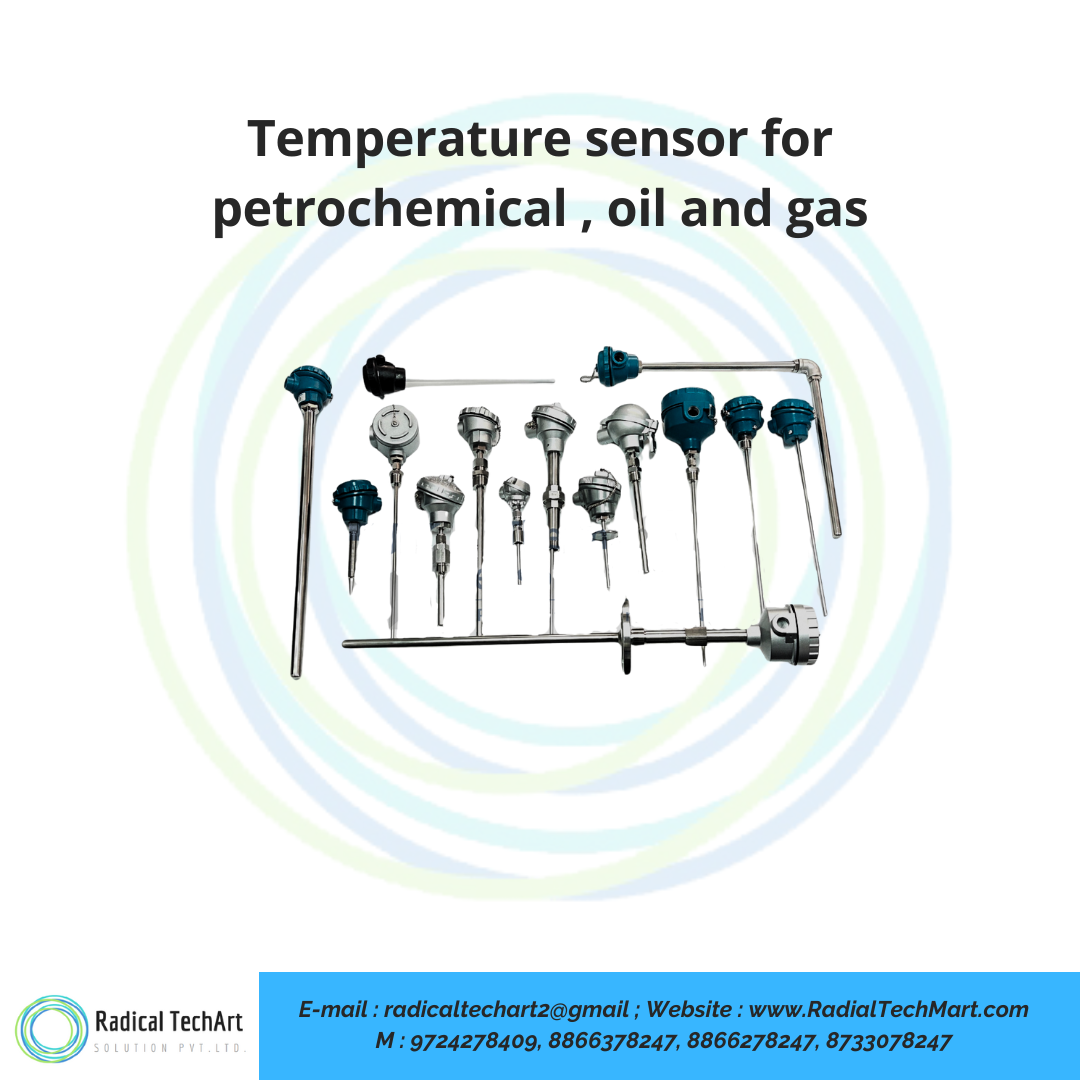
Industrial RTD Temperature Sensor for Oil and Gas Industry
Temperature sensors for petrochemical, oil and gas applications are designed for accurate and reliable temperature measurement in harsh industrial environments. Available in Pt100 RTD, J type and K type options, these sensors are suitable for pipelines, tanks, reactors, refineries, fuel systems, process vessels and high-temperature applications.
Customize
Share :
A. Product Overview
The Temperature Sensor for Petrochemical, Oil and Gas is an industrial temperature measurement device used to monitor process temperature in demanding and hazardous environments. These sensors are commonly used in refineries, petrochemical plants, oil processing units, gas pipelines, fuel storage systems and chemical process industries.
The sensor is available in Pt100 RTD, J type and K type configurations with simplex and duplex options. Pt100 RTD sensors are preferred where high accuracy, stability and repeatability are required, while J type and K type thermocouple options are suitable for higher temperature applications.
These sensors are built with robust sheath materials such as SS304, SS316, SS310 and Inconel to provide protection against corrosion, pressure, vibration, chemical exposure and mechanical damage.
Key Specifications
Type: Pt100, J type and K type, simplex and duplex
Temperature Range: -50°C to 500°C, 0°C to 600°C and 0°C to 1200°C
Probe Diameter: 6 mm to 16 mm, optional
Probe Length: 50 mm to 5000 mm
Accuracy: Class A or Class B as per IEC-60751
Sheath Material: SS304, SS316, SS310, Inconel and other suitable materials
B. Working Principle
A Pt100 RTD temperature sensor works on the principle of resistance change with temperature. The Pt100 element has a resistance of 100 ohms at 0°C. As the process temperature increases, the resistance of the platinum element also increases in a predictable manner.
This change in resistance is measured by a temperature transmitter, indicator, controller or PLC and converted into a temperature reading. Due to the stable and linear behavior of platinum, Pt100 RTD sensors provide accurate and repeatable temperature measurement in industrial applications.
For J type and K type thermocouple options, the sensor works on the thermoelectric principle. When two different metals are joined and exposed to temperature, a small voltage is generated. This voltage is measured and converted into temperature by the connected instrument.
C. Why It Is Used
Temperature sensors are used in petrochemical, oil and gas industries to maintain process safety, product quality and operational efficiency. In these industries, temperature directly affects pressure, flow, chemical reaction, fuel quality and equipment performance.
These sensors are used because they provide:
Accurate temperature measurement in harsh environments
Reliable performance under high temperature and pressure conditions
Protection against corrosion, vibration and chemical exposure
Stable output for process control and automation systems
Better safety in hazardous industrial areas
Improved monitoring of pipelines, tanks, reactors and process vessels
Compatibility with temperature transmitters, PLC systems, controllers and indicators
In oil and gas plants, even a small temperature variation can affect process efficiency and safety. That is why rugged RTD and thermocouple temperature sensors are essential for continuous monitoring.
D. Suitable Buyers
This product is suitable for buyers and industries such as:
Petrochemical plants
Oil refineries
Gas processing plants
Chemical industries
Fuel storage terminals
Pipeline monitoring companies
Process equipment manufacturers
Boiler and furnace manufacturers
Heat exchanger manufacturers
Skid manufacturers
EPC contractors
Instrumentation engineers
Maintenance departments
Automation system integrators
Panel manufacturers
OEM machine builders
Industrial purchase teams
Plant engineers and project engineers
FAQ
1. What is a temperature sensor for petrochemical, oil and gas applications?
It is an industrial temperature sensor designed to measure temperature in harsh process environments such as refineries, pipelines, tanks, reactors, fuel systems and chemical plants.
2. Which sensor type is used in this product?
The sensor is available in Pt100 RTD, J type and K type options. Pt100 is preferred for high accuracy, while J type and K type are suitable for higher temperature applications.
3. What is the temperature range of this sensor?
The available temperature ranges are -50°C to 500°C, 0°C to 600°C and 0°C to 1200°C, depending on the sensor type and construction.
4. What sheath material is available?
Common sheath materials include SS304, SS316, SS310 and Inconel. The material can be selected based on temperature, corrosion level, pressure and process media.
5. Why is Pt100 used in oil and gas applications?
Pt100 RTD sensors are used because they offer high accuracy, long-term stability and repeatable temperature measurement, which is important for process safety and product quality.
6. What is the difference between simplex and duplex sensors?
A simplex sensor has one sensing element, while a duplex sensor has two sensing elements inside the same probe. Duplex sensors are used where backup measurement or dual output is required.
7. Can this sensor be used in pipelines?
Yes, this temperature sensor can be used in pipelines for monitoring oil, gas, steam, fuel, chemicals and other process fluids.
8. Can this sensor be used with a thermowell?
Yes, it can be used with a thermowell to protect the sensor from high pressure, corrosion, flow impact and process media damage.
9. Is this sensor suitable for hazardous areas?
It can be designed for hazardous and harsh environments depending on the head type, sheath material, connection and application requirement.
10. What industries commonly use this temperature sensor?
It is commonly used in petrochemical plants, oil refineries, gas plants, chemical plants, power plants, fuel storage systems, process industries and industrial automation projects.