

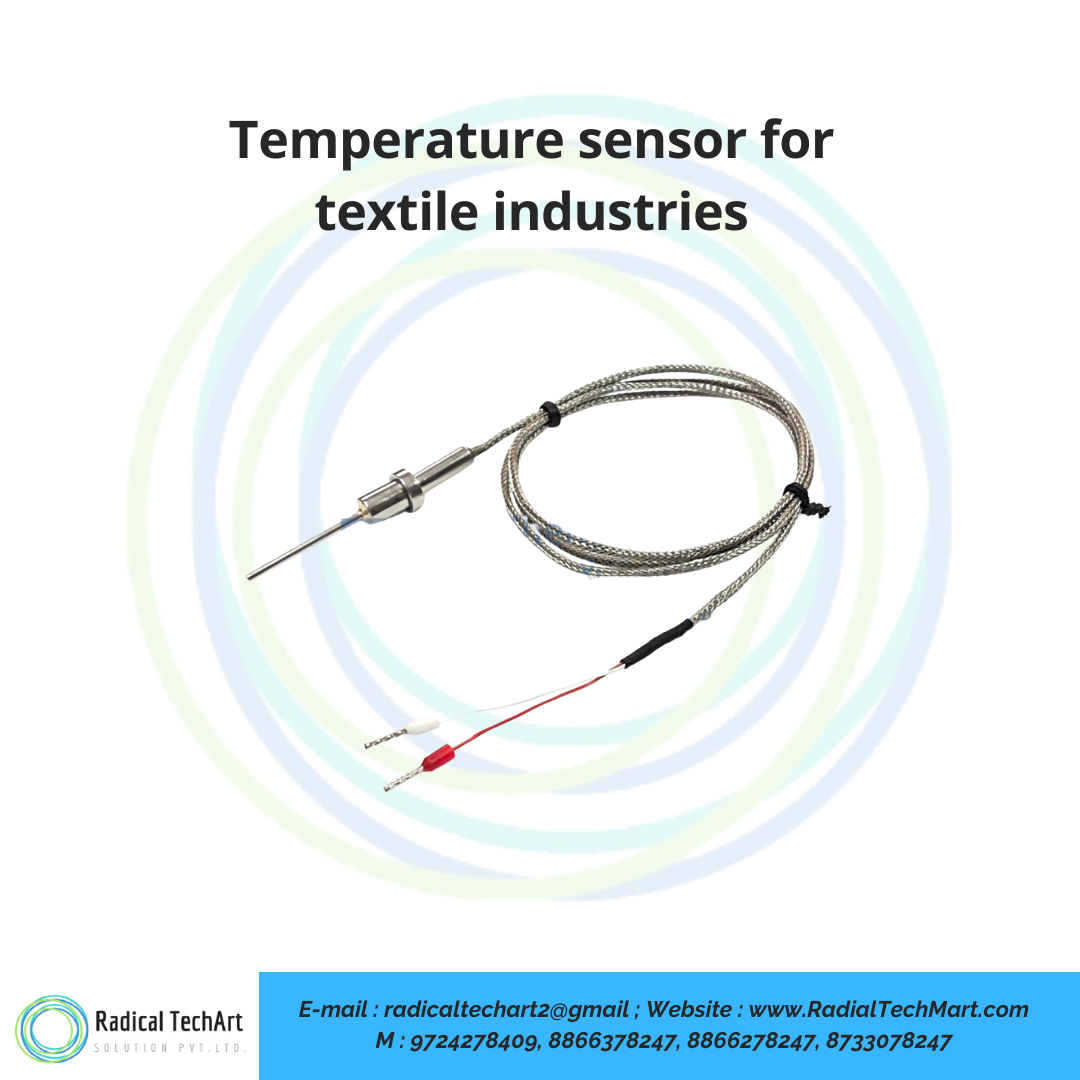


PT100 RTD Temperature Sensor for Textile Industries with SS Stopper
Temperature Sensor for Textile Industries is a Pt100 RTD sensor designed for accurate temperature measurement and control in textile processing machines. It is suitable for dyeing, finishing, drying, curing and other textile applications where stable temperature monitoring is required for better fabric quality and process consistency.
Customize
Share :
A. Product Overview
Temperature Sensor for Textile Industries is an RTD temperature sensor used for measuring and controlling temperature in textile machines and textile production processes. RTD stands for Resistance Temperature Detector. These sensors are widely used because they provide high accuracy, good sensitivity and long-term stability.
In textile industries, temperature control is very important because different processes require different temperature conditions. Dyeing, washing, finishing, drying and curing processes all depend on controlled temperature to achieve consistent fabric quality and proper processing results.
This sensor is commonly supplied with a Pt100 simplex element, SS stopper connection and Teflon, Teflon and stainless steel braided wire. Its compact tip design makes it suitable for textile machines where space is limited and quick temperature response is required.
Key Specifications
Element: Pt100 simplex
Temperature range: -50 to 400°C
Tip size: Diameter 2 mm and length 30 mm
Connection: SS stopper
Wire length: 1 meter Teflon, Teflon and stainless steel braided
Wire configuration: 2 wire
B. Working Principle
The Temperature Sensor for Textile Industries works on the RTD principle. Inside the sensor, there is a Pt100 element made from platinum. Pt100 means the sensor has a resistance of 100 ohms at 0°C.
When the temperature around the sensor tip changes, the resistance of the Pt100 element also changes. This resistance change is measured by a temperature controller, indicator, PLC or control panel. The instrument then converts the resistance value into a temperature reading.
For example, when the textile machine temperature increases during drying or curing, the RTD resistance increases. The controller reads this signal and helps maintain the required process temperature.
Because RTD sensors are stable and accurate, they are suitable for textile processes where precise temperature control is needed.
C. Why It Is Used
Temperature Sensor for Textile Industries is used to monitor and control temperature in textile machines and production lines. In textile processing, incorrect temperature can affect fabric quality, dye absorption, finishing result, drying time and overall production consistency.
This sensor is used for:
Accurate temperature measurement in textile machines
Temperature control in dyeing and finishing processes
Monitoring drying and curing temperature
Maintaining consistent fabric quality
Reducing process variation
Improving machine safety
Preventing overheating in textile equipment
Supporting automatic temperature control systems
Improving production efficiency
Reducing rejection and rework
RTD sensors are preferred in textile industries because they offer better accuracy, sensitivity and stability compared to many general-purpose temperature sensors.
D. Suitable Buyers
Temperature Sensor for Textile Industries is suitable for textile companies, machine manufacturers and maintenance teams that require reliable temperature measurement in production processes.
Suitable buyers include:
Textile mills
Dyeing plants
Textile finishing units
Fabric processing units
Textile machinery manufacturers
Dyeing machine manufacturers
Drying machine manufacturers
Curing machine manufacturers
OEM machine builders
Industrial maintenance teams
Process automation companies
Control panel manufacturers
Textile machine service providers
Spare parts suppliers for textile machinery
Production and quality control departments
This sensor is especially useful for industries where accurate temperature control directly affects product quality and process output.
FAQ
1. What is a Temperature Sensor for Textile Industries?
A Temperature Sensor for Textile Industries is a sensor used to measure and control temperature in textile machines and textile production processes such as dyeing, finishing, drying and curing.
2. What type of sensor is used in this product?
This product uses an RTD sensor element. As per the given specification, it uses a Pt100 simplex element.
3. What is Pt100 in an RTD sensor?
Pt100 is a platinum RTD element that has 100 ohms resistance at 0°C. Its resistance changes with temperature, and this change is used to calculate the temperature.
4. Why are RTD sensors used in textile industries?
RTD sensors are used because they provide accurate, stable and repeatable temperature measurement. Textile processes require precise temperature control for better fabric quality and consistent production.
5. What is the temperature range of this sensor?
As per the given specification, the temperature range is -50 to 400°C.
6. Where can this textile temperature sensor be used?
It can be used in dyeing machines, finishing machines, drying machines, curing equipment, textile processing machines and other textile production applications.
7. What is the tip size of this sensor?
The given sensor has a tip diameter of 2 mm and a tip length of 30 mm.
8. What is the wire configuration of this sensor?
As per the given data, this sensor has a 2 wire configuration.
9. What type of wire is used with this sensor?
The sensor is supplied with 1 meter Teflon, Teflon and stainless steel braided wire. This helps provide protection and durability in textile machine applications.
10. What is the connection type of this sensor?
The given sensor comes with an SS stopper connection.
11. Can this sensor be used for dyeing machines?
Yes, this sensor is suitable for dyeing machines where accurate temperature measurement is required for proper dyeing quality and process control.
12. Who should buy this temperature sensor?
Textile mills, dyeing plants, finishing units, textile machinery manufacturers, OEMs, control panel builders and maintenance teams should buy this sensor for textile process temperature monitoring.