

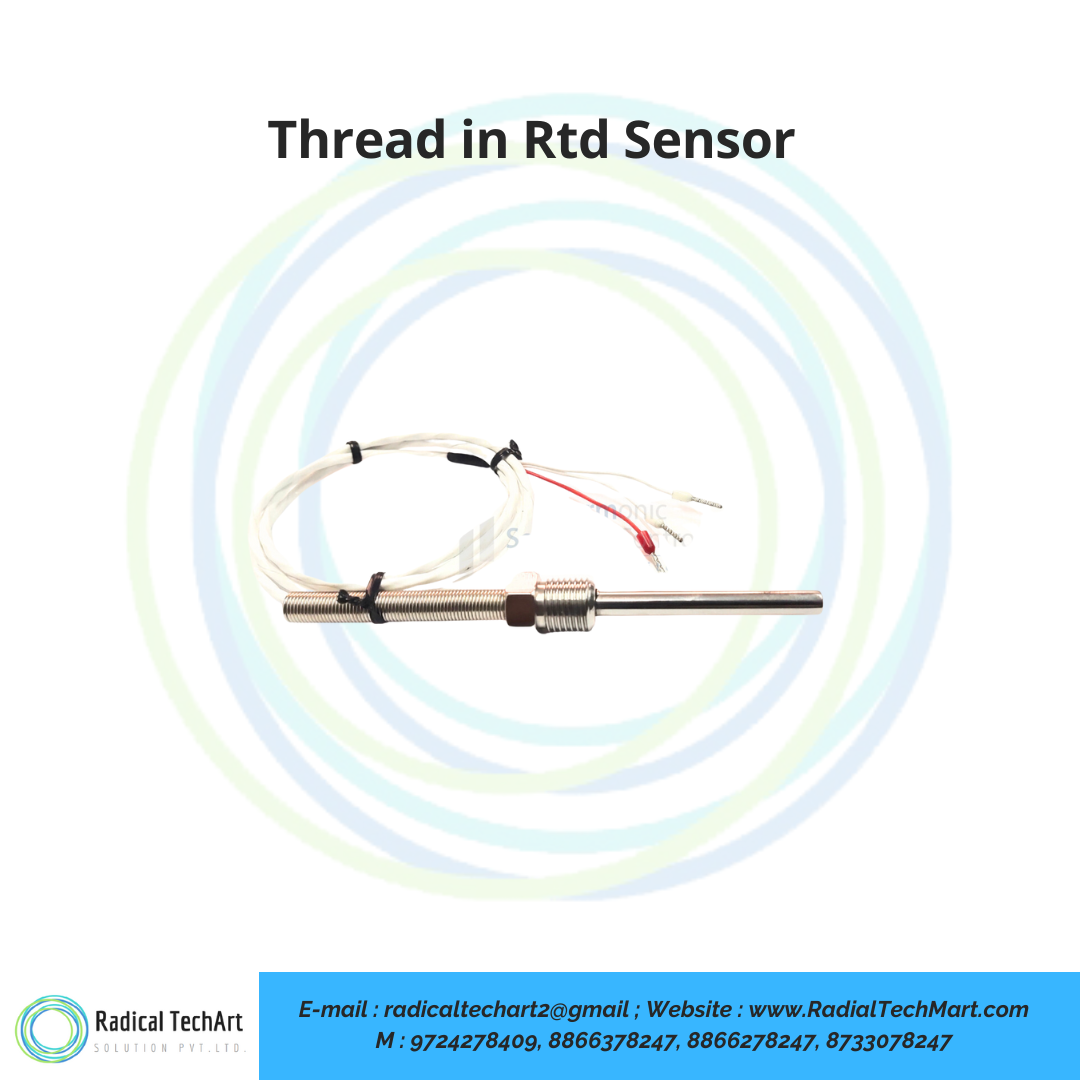
Thread-In RTD Sensor with Cable | Pt100 Temperature Probe
The Thread-In RTD Sensor is a Pt100 temperature sensor designed for accurate measurement of liquids and gases. It comes with a strong thread connection for reliable installation in vacuum, overpressure, refrigeration, air conditioning, heater, furnace and apparatus construction applications.
Customize
Share :
A. Product Overview
The Thread-In RTD Sensor is used for measuring temperature in liquids and gases where a strong and reliable process connection is required. This sensor is suitable for industrial applications where the probe needs to be securely installed into equipment, tanks, pipelines, vessels or machinery.
It is commonly used in air conditioning, refrigeration technology, heater systems, furnace applications, apparatus construction, machinery, plant equipment and industrial process control.
This sensor is available with Pt100 simplex or duplex element, making it suitable for both standard temperature measurement and applications where dual sensing or backup measurement is required.
Key Specifications
Element: Pt100 Simplex or Duplex
Temperature Range: -50 to 500 °C
Probe Diameter: 3 mm to 10 mm
Probe Length: 15 mm to 300 mm
Thread Connection: 1/8 inch, 1/4 inch, 3/8 inch, 1/2 inch and 3/4 inch in BSP or NPT
Wire Length: 1 meter to 10 meter
Accuracy: Class A or Class B as per IEC-60751
B. Working Principle
The Thread-In RTD Sensor works on the resistance temperature detector principle. The Pt100 element inside the probe changes its electrical resistance when temperature changes.
When the probe tip comes in contact with liquid, gas or the process area, the Pt100 element senses the temperature. This resistance signal is then sent through the cable to a temperature controller, indicator, transmitter, PLC or monitoring system. The connected device converts the resistance value into a temperature reading.
The thread connection helps the sensor remain fixed in position and creates a reliable sealing arrangement for vacuum and overpressure applications.
C. Why It Is Used
The Thread-In RTD Sensor is used when accurate temperature measurement, strong mounting and reliable sealing are required. It is preferred in applications where the sensor must be fitted directly into a machine, pipe, vessel, tank or process equipment.
It is especially useful in liquid and gas temperature measurement because the thread connection helps prevent loose fitting and supports stable measurement in industrial conditions.
Main Benefits
Accurate Pt100 temperature measurement
Suitable for liquids and gases
Strong thread connection for secure installation
Useful for vacuum and overpressure applications
Available in BSP or NPT thread options
Suitable for air conditioning and refrigeration systems
Useful in heater, furnace and apparatus construction
Available in simplex and duplex element options
Class A and Class B accuracy options
Cable length options from 1 meter to 10 meter
D. Suitable Buyers
This Thread-In RTD Sensor is suitable for:
Industrial machinery manufacturers
HVAC system manufacturers
Refrigeration system manufacturers
Furnace manufacturers
Heater manufacturers
Apparatus and equipment manufacturers
Chemical plants
Pharmaceutical plants
Food processing plants
Process industries
Tank and vessel manufacturers
Pipeline system manufacturers
Automation system integrators
Panel builders
Maintenance engineers
OEM machine builders
FAQ
1. What is a Thread-In RTD Sensor?
A Thread-In RTD Sensor is a Pt100 temperature sensor used for measuring temperature in liquids and gases. It has a thread connection that allows easy installation into equipment, tanks, pipelines, vessels and machinery.
2. Where is a Thread-In RTD Sensor used?
It is used in air conditioning, refrigeration technology, heater systems, furnace applications, apparatus construction, machinery, plant equipment, pipelines, tanks and industrial process control.
3. What is the temperature range of this sensor?
The temperature range of this Thread-In RTD Sensor is -50 to 500 °C.
4. Which sensing element is used in this RTD sensor?
This sensor uses a Pt100 element. It is available in simplex and duplex options depending on the application requirement.
5. What is the difference between simplex and duplex RTD sensor?
A simplex RTD sensor has one sensing element. A duplex RTD sensor has two sensing elements inside the same probe, which can be useful for backup measurement or connecting two separate instruments.
6. What thread connection options are available?
This sensor is available in 1/8 inch, 1/4 inch, 3/8 inch, 1/2 inch and 3/4 inch thread sizes in BSP or NPT options.
7. Can this sensor be used in vacuum applications?
Yes, the Thread-In RTD Sensor is suitable for vacuum applications because the thread connection can help form a reliable seal.
8. Can this sensor be used in overpressure applications?
Yes, it can be used in overpressure applications when the correct thread size, probe design and installation arrangement are selected.
9. What wire length is available?
The available wire length is 1 meter to 10 meter, depending on the requirement.
10. What accuracy options are available?
This RTD sensor is available in Class A or Class B accuracy as per IEC-60751.
11. Can this sensor be connected to a temperature controller?
Yes, this sensor can be connected to a temperature controller, temperature indicator, transmitter, PLC or monitoring system that supports Pt100 RTD input.
12. Who should buy a Thread-In RTD Sensor?
This product is suitable for OEMs, machinery manufacturers, HVAC companies, refrigeration companies, furnace manufacturers, heater manufacturers, pharmaceutical plants, process industries and maintenance teams.