

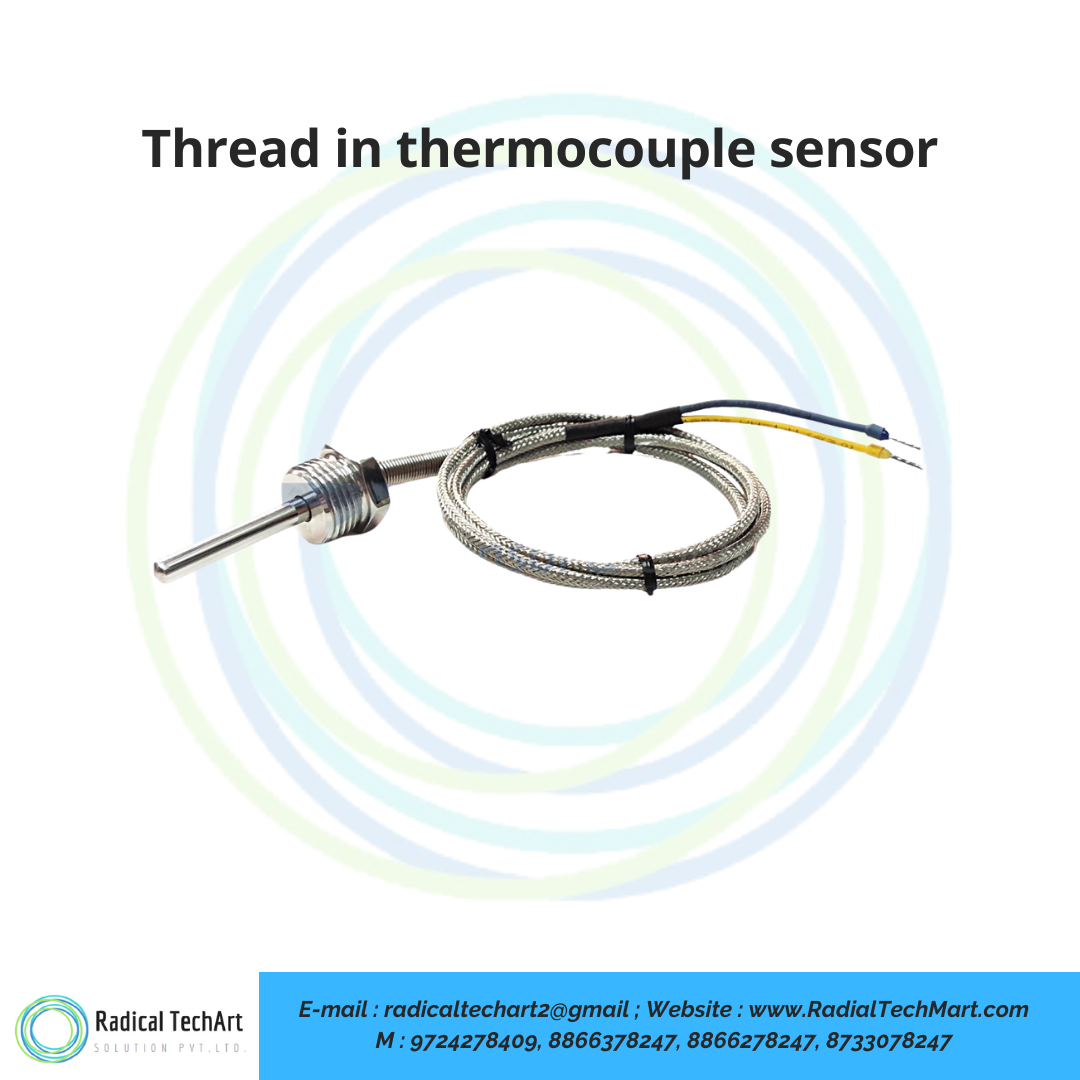
Thread In Thermocouple Sensor With BSP and NPT Thread
Thread in thermocouple sensor is a threaded temperature sensor used for accurate temperature measurement in industrial equipment, heating systems, cooling systems, engines, machines and process applications. Its screw type design provides secure installation, direct contact with the material and stable temperature sensing in demanding environments.
Customize
Share :
A. Product Overview
A thread in thermocouple sensor is a temperature sensor designed to be screwed or threaded into a hole, port or opening in a machine, tank, pipeline, engine or process equipment. The threaded fitting helps the sensor stay firmly fixed in place and allows direct contact with the material or process area where temperature measurement is required.
This type of thermocouple is commonly used in industrial applications where a stable, durable and removable temperature sensor is needed. The probe is usually made from stainless steel, Inconel or other thermally conductive alloys to ensure accurate and reliable temperature sensing.
Thread in thermocouple sensors are available in different thermocouple types such as J, K, T and E. RTD options can also be supplied as per requirement. The probe size, thread size, wire length and junction type can be customized according to the application.
Common specifications:
Type: J, K, T, E and RTD
Temperature Range: -50 to 500 °C
Tip Size: Diameter 3 to 12 mm and length 20 to 500 mm
Thread Size: 1/4, 3/8, 1/2 and 3/4 inch in BSP and NPT
Wire Length: 0.5 meter to 10 meter
Junction: Grounded and ungrounded
B. Working Principle
Thread in thermocouple sensors work on the thermocouple principle. Two different metal wires are joined at one sensing end. When this junction is exposed to heat, it generates a small voltage. This voltage changes according to the temperature at the sensing point.
The threaded probe is inserted into the process or equipment, allowing the sensing tip to make direct contact with the medium or surface. The thermocouple wires carry the generated signal to a temperature controller, indicator, transmitter, data logger or PLC input module.
The connected instrument converts the thermocouple signal into a readable temperature value. A grounded junction can be selected when fast response is required, while an ungrounded junction is useful where electrical isolation and signal stability are important.
C. Why It Is Used
Thread in thermocouple sensors are used because they provide strong mechanical fitting, accurate temperature measurement and easy installation. The threaded design keeps the sensor fixed properly and reduces the chance of movement, damage or loose contact during operation.
They are preferred in applications where direct temperature measurement is required inside equipment, pipelines, engines, heating systems or process machinery. Compared to surface mounted sensors, thread in thermocouples are more stable and less likely to get displaced during machine operation.
These sensors are also useful because they can be customized with different probe materials, thread sizes, wire lengths, insulation types and junction options. Waterproof or explosion proof housing can also be provided for applications where moisture, dust, gas or hazardous environments are present.
D. Suitable Buyers
This product is suitable for buyers who require direct contact temperature measurement in industrial and mechanical applications.
Suitable buyers include:
Industrial automation companies
OEM machine manufacturers
Heating system manufacturers
Cooling system manufacturers
Automotive engine manufacturers
Boiler and furnace manufacturers
Plastic machinery manufacturers
Chemical process industries
Pharmaceutical industries
Food processing plants
Power plants
Instrumentation engineers
Maintenance teams
Panel builders
System integrators
Temperature sensor dealers and distributors
FAQ
1. What is a thread in thermocouple sensor?
A thread in thermocouple sensor is a temperature sensor with a threaded fitting that can be screwed into a hole or process connection for direct temperature measurement.
2. Where is a thread in thermocouple sensor used?
It is used in industrial equipment, heating systems, cooling systems, automotive engines, pipelines, machines, tanks, boilers, furnaces and process applications.
3. What is the benefit of threaded installation?
Threaded installation provides secure fitting, stable contact, easy removal and better durability during operation.
4. Which thermocouple types are available?
Common options include Type J, Type K, Type T and Type E. RTD options can also be supplied as per requirement.
5. What temperature range does this sensor support?
The common temperature range is -50 to 500 °C, depending on the sensor type, probe material, wire insulation and application condition.
6. What thread sizes are available?
Common thread sizes include 1/4 inch, 3/8 inch, 1/2 inch and 3/4 inch in BSP and NPT thread options.
7. Can the probe size be customized?
Yes, the probe diameter and length can be customized. Common tip diameter options are 3 to 12 mm, and common tip length options are 20 to 500 mm.
8. What is the difference between grounded and ungrounded junction?
A grounded junction gives faster response because the sensing junction is connected to the probe sheath. An ungrounded junction provides better electrical isolation and helps reduce signal interference.
9. Can this sensor be used in wet or dusty areas?
Yes, it can be supplied with suitable protection such as waterproof housing, proper insulation and rugged probe construction for wet, dusty or harsh environments.
10. Why should I choose a thread in thermocouple instead of a surface sensor?
A thread in thermocouple provides stronger installation, better direct contact and more stable temperature reading. It is less likely to move, loosen or get damaged compared to surface mounted sensors.