

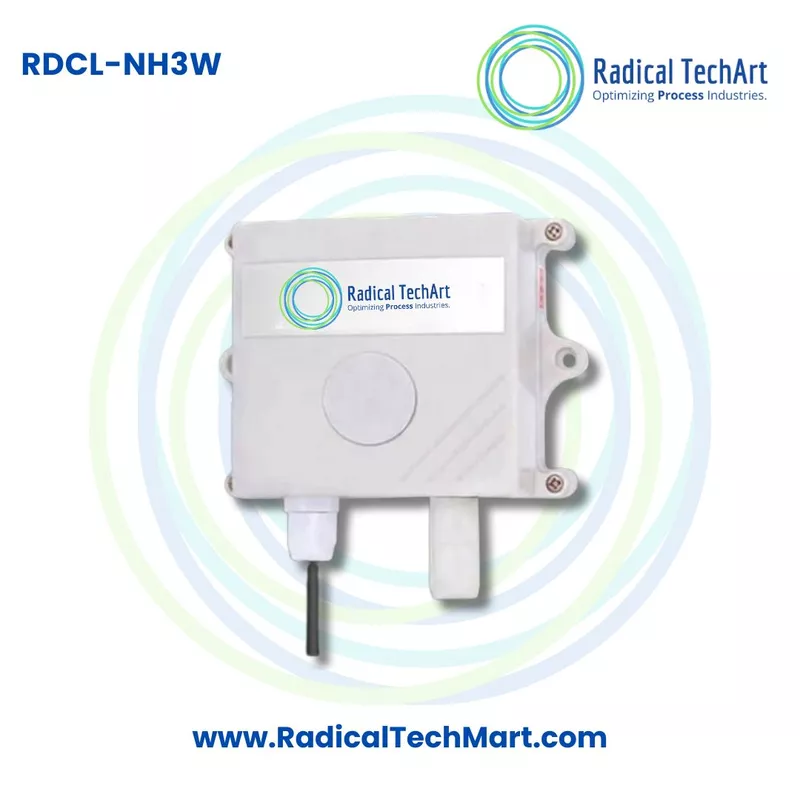


Wall Mount Ammonia (NH3) Gas Sensor and Transmitter | RDCL-NH3W
The RDCL-NH3W Wall Mount Ammonia (NH3) Gas Sensor and Transmitter is designed for accurate and continuous monitoring of ammonia gas concentration in industrial, agricultural and commercial environments. Featuring electrochemical sensing technology, it provides sensitive and stable ammonia measurement with 0 to 50 ppm, 0 to 100 ppm and 0 to 500 ppm range options. The transmitter supports RS485, 4 to 20 mA and voltage outputs for integration with PLC, SCADA and ventilation control systems. Ideal for poultry farms, livestock facilities, fertilizer plants, chemical industries, cold storage refrigeration areas and environmental monitoring applications.
Customize
Share :
A. Product Overview
The RDCL-NH3W Wall Mount Ammonia Gas Sensor and Transmitter is designed for continuous ammonia gas concentration monitoring in industrial and agricultural environments. It uses electrochemical sensing technology to detect ammonia (NH3) in ambient air and convert the measurement into an electrical output signal.
The transmitter is suitable for poultry farms, livestock buildings, fertilizer manufacturing, chemical processing, refrigeration facilities and industrial environmental monitoring applications.
It supports multiple measurement ranges and output configurations, enabling integration with compatible PLC, SCADA, data acquisition and ventilation monitoring systems.
Key Features
Electrochemical ammonia gas sensing technology
Measurement ranges of 0 to 50 ppm, 0 to 100 ppm and 0 to 500 ppm
RS485, 4 to 20 mA, 0 to 5V and 0 to 10V output options
Continuous ammonia concentration monitoring
Operating voltage of 10 to 30V DC
Low power consumption
Wall mounted industrial enclosure
Signal compensation for stable measurements
Optional OLED display
Optional temperature and humidity measurement
Suitable for industrial automation and agricultural monitoring
Technical Specifications
Parameter | Specification |
|---|---|
Model | RDCL-NH3W |
Product Type | Wall Mount Ammonia Gas Sensor and Transmitter |
Gas Detected | Ammonia (NH3) |
Sensing Technology | Electrochemical |
Measurement Ranges | 0 to 50 ppm, 0 to 100 ppm, 0 to 500 ppm |
Accuracy, 50 and 100 ppm | ±8% under specified conditions |
Accuracy, 500 ppm | ±5% FS under specified conditions |
Resolution | 0.1 ppm or 1 ppm, depending on range |
Output Options | RS485, 4 to 20 mA, 0 to 5V, 0 to 10V |
Power Supply | 10 to 30V DC |
Power Consumption | Approximately 0.12W |
Response Time | Up to 90 seconds or 25 seconds, depending on range |
Operating Temperature | −20°C to 50°C |
Operating Humidity | 15% to 90% RH, non-condensing |
Mounting | Wall Mount |
Optional Display | OLED |
Specifications vary according to the selected configuration. Confirm the required measurement range, output and optional features before ordering.
B. Working Principle
The RDCL-NH3W operates using the electrochemical ammonia gas sensing principle. It detects ammonia molecules in ambient air and converts their concentration into a measurable electrical signal.
Step 1: Ammonia Detection
Ammonia gas from the surrounding atmosphere enters the sensor through a gas permeable opening and reaches the electrochemical sensing element.
Step 2: Electrochemical Reaction
Ammonia interacts with the sensing electrode and produces an electrical current related to the ammonia concentration.
Step 3: Signal Processing
The internal electronics process the sensor signal using calibration and compensation techniques to determine the ammonia concentration.
Step 4: Concentration Measurement
The transmitter converts the processed signal into a concentration value expressed in parts per million (ppm).
Step 5: Output Transmission
The measured ammonia concentration is transmitted through the selected RS485 or analog output to compatible monitoring equipment.
Step 6: Monitoring and Ventilation Control
A connected PLC or monitoring system can display ammonia readings, record measurements and control ventilation or alarms according to programmed thresholds.
This process enables continuous ammonia monitoring without requiring repeated manual gas sampling.
C. Why Is the RDCL-NH3W Used?
The RDCL-NH3W is used in environments where ammonia can be generated, stored, processed or released. Continuous NH3 monitoring supports environmental management, process supervision and ventilation control.
1. Poultry Farm Ammonia Monitoring
Ammonia generated from poultry manure can affect bird health and environmental conditions. The transmitter helps operators monitor ammonia concentration and identify ventilation requirements.
2. Livestock Farm Monitoring
In cattle sheds, pig farms and other livestock facilities, the sensor helps monitor ammonia produced during animal waste decomposition.
3. Fertilizer Manufacturing
Ammonia is used in fertilizer production. The transmitter supports ambient NH3 monitoring in suitable manufacturing and handling areas.
4. Chemical Processing Plants
The RDCL-NH3W helps monitor ammonia concentration around selected chemical processing and storage equipment.
5. Industrial Refrigeration Facilities
Ammonia is used as a refrigerant in industrial refrigeration systems. The transmitter may be used for compatible ambient monitoring applications. Safety critical leak detection requires appropriately certified detection equipment.
6. Industrial Ventilation Control
The transmitter provides ammonia measurements to compatible PLC systems, allowing ventilation equipment to operate based on configured concentration thresholds.
7. Agricultural Greenhouses
The sensor supports ammonia concentration monitoring in agricultural environments involving fertilizers and organic waste.
8. Environmental Monitoring
Continuous NH3 measurement helps industrial and agricultural operators observe changes in ambient air conditions.
9. Industrial Automation
RS485 and analog output options enable integration into compatible PLC, SCADA and industrial data acquisition systems for centralized monitoring.
D. Suitable Buyers
The RDCL-NH3W is suitable for businesses and professionals requiring fixed ammonia concentration monitoring.
Suitable Buyers | Applications |
|---|---|
Poultry Farm Owners | Poultry house ammonia monitoring |
Livestock Farm Operators | NH3 monitoring in animal housing |
Fertilizer Manufacturers | Ammonia monitoring in production areas |
Chemical Industries | Ambient ammonia concentration measurement |
Refrigeration Contractors | Compatible industrial refrigeration monitoring |
Greenhouse Operators | Agricultural ammonia monitoring |
Pharmaceutical Manufacturers | Selected chemical process monitoring |
Industrial Automation Companies | PLC and SCADA integration |
OEM Manufacturers | Integration into monitoring equipment |
Ventilation System Integrators | Ammonia based ventilation monitoring |
Environmental Monitoring Companies | Industrial and agricultural air monitoring |
Research Laboratories | Experimental ammonia measurement |
EPC Contractors | Industrial gas monitoring projects |
The RDCL-NH3W is particularly relevant for poultry farms, livestock facilities, fertilizer plants, agricultural automation companies and industrial system integrators requiring continuous ammonia measurement.
E. Frequently Asked Questions
1. What is the RDCL-NH3W Ammonia Gas Sensor?
The RDCL-NH3W is a wall mounted electrochemical ammonia gas sensor and transmitter designed to measure NH3 concentration continuously in ambient air.
2. What is the working principle of the RDCL-NH3W?
It uses electrochemical sensing technology. Ammonia reacts at the sensing electrode, generating an electrical signal related to NH3 concentration. The transmitter processes this signal into a ppm measurement.
3. What measurement ranges are available?
Available reference ranges include 0 to 50 ppm, 0 to 100 ppm and 0 to 500 ppm.
4. Does the RDCL-NH3W support RS485 communication?
Yes. RS485 is available as an output option for integration with compatible industrial controllers and monitoring systems.
5. Is a 4 to 20 mA output available?
Yes. A 4 to 20 mA analog output is available for connection to compatible industrial instruments and PLC analog input modules.
6. Can the ammonia sensor connect to a PLC?
Yes. The transmitter can connect to a compatible PLC using the selected RS485 or analog output interface.
7. Is the RDCL-NH3W suitable for poultry farms?
Yes. It can monitor ammonia generated by poultry waste and provide concentration measurements that support ventilation management.
8. Which measurement range is suitable for poultry farms?
A 0 to 100 ppm configuration may be considered, depending on the expected ammonia concentration, required resolution and application.
9. Can the sensor be used in cold storage facilities?
Yes, for compatible ambient ammonia monitoring. Safety critical refrigeration leak detection requires a properly engineered and certified gas detection system.
10. What is the accuracy of the RDCL-NH3W?
Reference configurations specify ±8% accuracy for the 50 ppm and 100 ppm ranges and ±5% of full scale for the 500 ppm range under specified conditions.
11. What is the response time?
The reference response time is up to 90 seconds for the 50 ppm and 100 ppm configurations and up to 25 seconds for the 500 ppm configuration.
12. What power supply is required?
The transmitter operates on a 10 to 30V DC power supply.
13. Does the ammonia transmitter have a display?
An OLED display is available in selected configurations for local ammonia concentration indication.
14. Can the sensor measure temperature and humidity?
Selected configurations support additional temperature and humidity monitoring. This feature should be confirmed before ordering.
15. Where can I buy the RDCL-NH3W Ammonia Gas Sensor in India?
You can contact Radical TechMart for RDCL-NH3W pricing, suitable measurement range selection, output configuration, availability and delivery details.