

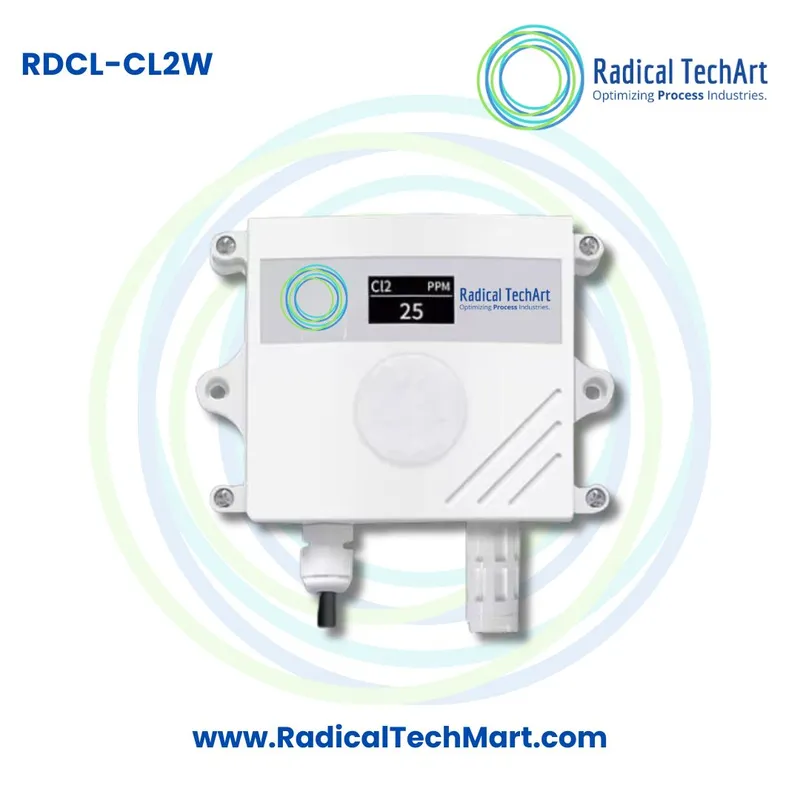


Wall Mount Chlorine (Cl2) Gas Sensor and Transmitter | RDCL-CL2W
The RDCL-CL2W Wall Mount Chlorine (Cl2) Gas Sensor and Transmitter is designed for continuous chlorine gas concentration monitoring in industrial and commercial environments. Featuring advanced electrochemical sensing technology, it offers measurement range options of 0 to 20 PPM, 0 to 50 PPM and 0 to 100 PPM, with RS485, 4 to 20mA, 0 to 5V and 0 to 10V output options. Its temperature compensation, stable measurement performance, protective enclosure and optional OLED display make it suitable for chemical plants, water treatment facilities, chlorine storage areas, laboratories and industrial gas monitoring applications.
Customize
Share :
A. Product Overview
The RDCL-CL2W Wall Mount Chlorine Gas Sensor and Transmitter is an industrial instrument designed for continuous chlorine (Cl2) gas monitoring. Chlorine is a toxic gas widely used in water treatment, chemical manufacturing and industrial processing. Monitoring airborne chlorine helps identify elevated concentrations and potential leakage.
The RDCL-CL2W uses electrochemical sensing technology and offers 0 to 20 ppm, 0 to 50 ppm and 0 to 100 ppm measurement ranges. RS485 and analog output options enable integration with compatible PLC, SCADA and industrial monitoring systems.
Key Features and Technical Specifications
Parameter | Specification |
|---|---|
Model | RDCL-CL2W |
Product Type | Wall Mount Chlorine Gas Sensor and Transmitter |
Target Gas | Chlorine (Cl2) |
Sensing Technology | Electrochemical |
Measurement Ranges | 0 to 20, 0 to 50 or 0 to 100 ppm |
Accuracy | ±10% |
Resolution | 0.1 ppm for 20 and 50 ppm, 1 ppm for 100 ppm |
Output Options | RS485, 4 to 20 mA, 0 to 5V, 0 to 10V |
Power Supply | 10 to 30V DC |
Power Consumption | 0.25W |
Response Time | ≤60 seconds |
Preheating Time | At least 5 minutes |
Repeatability | ≤3% |
Zero Drift | ±3% FS |
Stability | ≤2% of signal value per month |
Operating Temperature | −20°C to 50°C |
Operating Humidity | 15% to 90% RH, non-condensing |
Operating Pressure | 90 to 110 kPa |
Sensor Service Life | At least 24 months under specified conditions |
Display | Optional OLED |
Installation | Wall Mount |
Main Advantages
Continuous electrochemical chlorine gas monitoring
Multiple measurement ranges for different applications
RS485 and analog outputs for industrial automation
Temperature compensation for measurement stability
Protective wall mounted enclosure
Optional OLED display for local readings
Suitable for fixed industrial monitoring installations
B. Working Principle
The RDCL-CL2W Chlorine Gas Sensor uses electrochemical sensing technology to measure chlorine concentration in ambient air.
1. Gas Detection: Chlorine gas enters the sensing chamber through a gas permeable membrane.
2. Electrochemical Reaction: Chlorine reacts at the sensing electrode, generating an electrical current related to its concentration.
3. Signal Processing: Internal electronics process the signal and calculate chlorine concentration in parts per million (ppm).
4. Signal Compensation: Calibration data and temperature compensation help maintain measurement stability.
5. Output Transmission: The measured concentration is transmitted through RS485, 4 to 20 mA, 0 to 5V or 0 to 10V, depending on configuration.
6. Continuous Monitoring: Connected PLC, SCADA or monitoring systems can display readings, record data and initiate configured control actions.
C. Why Is the RDCL-CL2W Used?
The RDCL-CL2W monitors chlorine gas in industrial environments where chlorine is manufactured, stored, handled or used.
1. Chlorine Gas Leakage Monitoring: Helps identify increasing airborne chlorine concentration near pipelines, valves, storage equipment and processing systems.
2. Water Treatment Plants: Monitors chlorine gas around water disinfection equipment and chlorine dosing rooms.
3. Sewage Treatment Plants: Supports ambient chlorine monitoring in disinfection and chemical handling areas.
4. Chemical Manufacturing: Measures chlorine concentration around selected chemical processing and storage installations.
5. Chlorine Storage Rooms: Provides fixed monitoring near chlorine cylinders and gas supply equipment.
6. Industrial Environmental Monitoring: Supports continuous chlorine concentration measurement at selected monitoring locations.
7. PLC and SCADA Integration: Enables centralized monitoring, data recording and automation through compatible systems.
8. Laboratory Applications: Measures ambient chlorine in suitable chemical laboratories and research facilities.
Common Applications
Water and wastewater treatment plants
Chemical and pharmaceutical manufacturing
Chlorine storage and handling facilities
Water disinfection equipment rooms
Chemical laboratories
Industrial ventilation monitoring
PLC and SCADA gas monitoring systems
Safety Note: The referenced sensor family is not recommended by its manufacturer for personal safety applications. The RDCL-CL2W should not replace certified chlorine gas safety detectors or serve as the sole means of personnel protection.
D. Suitable Buyers
Suitable Buyers | Applications |
|---|---|
Water Treatment Plant Operators | Chlorine dosing area monitoring |
Sewage Treatment Plant Operators | Disinfection area monitoring |
Chemical Manufacturers | Industrial chlorine gas monitoring |
Chlorine Storage Facilities | Airborne chlorine measurement |
Industrial Automation Integrators | RS485 and analog integration |
PLC and SCADA Integrators | Centralized gas monitoring |
Water Treatment Equipment OEMs | Equipment monitoring applications |
Environmental Monitoring Companies | Industrial chlorine measurement |
Chemical Laboratories | Ambient chlorine monitoring |
EPC Contractors | Industrial instrumentation projects |
Pharmaceutical Manufacturers | Chlorine handling area monitoring |
Industrial Instrument Suppliers | Chlorine transmitter procurement |
E. Frequently Asked Questions
1. What is the RDCL-CL2W Chlorine Gas Sensor?
The RDCL-CL2W is a wall mounted electrochemical chlorine gas sensor and transmitter designed for continuous airborne chlorine concentration monitoring.
2. What measurement ranges are available?
Available ranges are 0 to 20 ppm, 0 to 50 ppm and 0 to 100 ppm.
3. How does the chlorine gas sensor work?
It detects chlorine through an electrochemical reaction that produces an electrical signal related to the gas concentration.
4. What output signals are available?
RS485, 4 to 20 mA, 0 to 5V and 0 to 10V, depending on the selected configuration.
5. Can it connect to a PLC?
Yes. Compatible PLC systems can receive chlorine measurements through analog or RS485 interfaces.
6. Is it suitable for water treatment plants?
Yes. It can monitor airborne chlorine near dosing equipment, chlorine handling rooms and suitable disinfection facilities.
7. Can it detect chlorine gas leakage?
It measures airborne chlorine and can indicate elevated concentrations associated with potential leaks. It is not a replacement for certified personnel safety detection equipment.
8. Does it have a display?
An optional OLED display is available for local chlorine concentration readings.
9. What power supply is required?
The transmitter operates on 10 to 30V DC.
10. What is the response time?
The specified response time is 60 seconds or less.
11. What is the operating temperature?
The operating temperature range is −20°C to 50°C.
12. What is the difference between a chlorine gas sensor and a water chlorine sensor?
A chlorine gas sensor measures chlorine concentration in air, while a water chlorine sensor measures dissolved or residual chlorine in water. They are not interchangeable.