

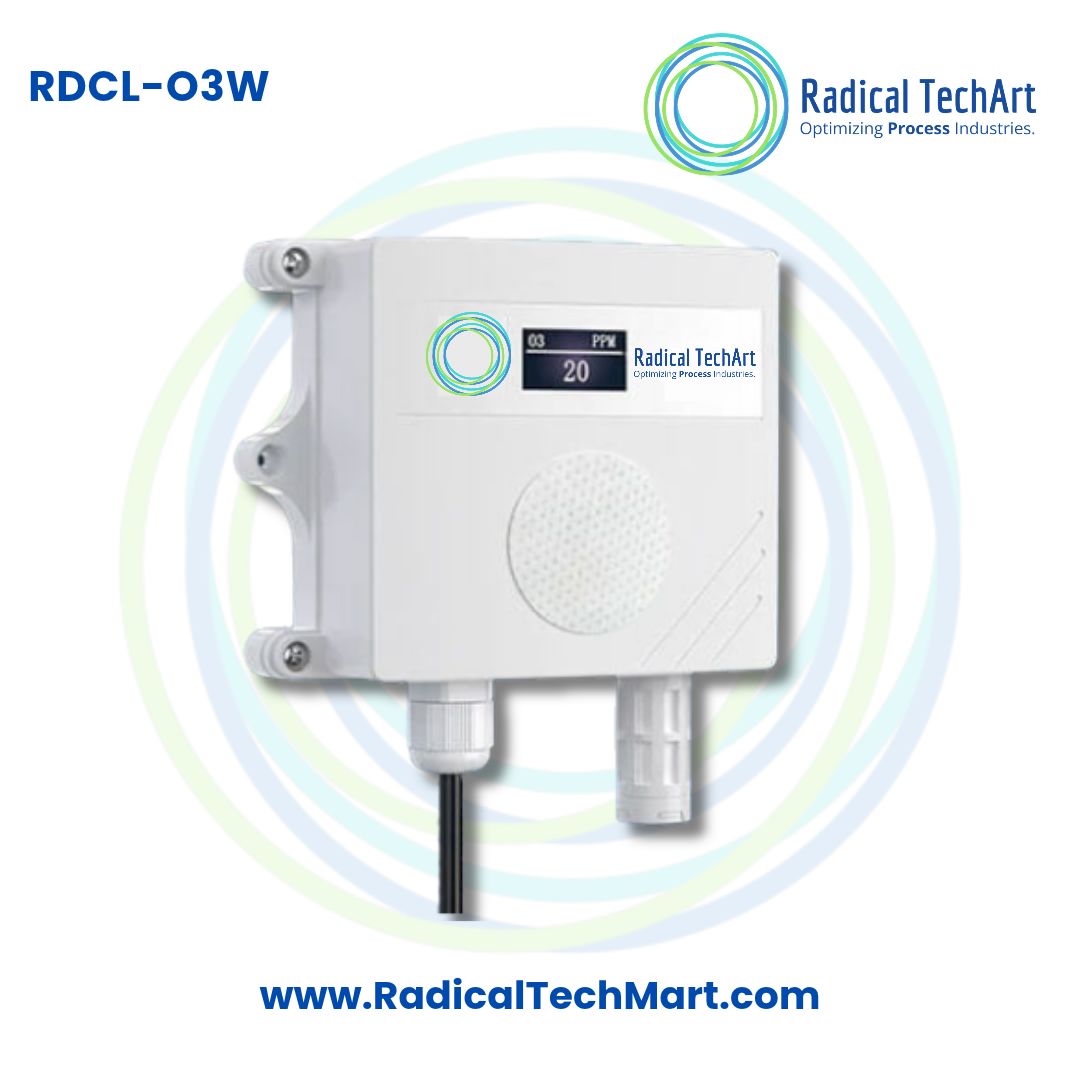


Wall Mount Ozone (O3) Gas Sensor and Transmitter | RDCL-O3W
The RDCL-O3W Wall Mount Ozone (O3) Gas Sensor and Transmitter is designed for continuous monitoring of ozone gas concentration in industrial and commercial environments. Featuring electrochemical sensing technology, it provides sensitive and reliable ozone measurement for air quality monitoring, ozone disinfection systems, water treatment facilities and industrial safety applications. The wall mounted design allows convenient fixed installation, with output options such as RS485 Modbus RTU, 4 to 20 mA, 0 to 5V and 0 to 10V for integration with compatible monitoring and automation systems.
Customize
Share :
A. Product Overview
The RDCL-O3W Wall Mount Ozone Gas Sensor and Transmitter is designed for continuous measurement of ozone (O3) concentration in ambient air. It supports fixed monitoring in water treatment plants, ozone generator rooms, pharmaceutical facilities, food processing areas and industrial installations.
Ozone is used for disinfection, sterilization and treatment processes, but excessive airborne concentrations can affect respiratory health. The RDCL-O3W uses electrochemical sensing technology to convert ozone concentration into an electrical signal for compatible PLC, SCADA, controller or monitoring systems.
Key Features
- Continuous electrochemical ozone gas measurement.
- Wall-mounted design for fixed industrial installation.
- Measurement ranges: 0 to 10 ppm or 0 to 100 ppm.
- Output options: RS485, 4 to 20 mA, 0 to 5 V and 0 to 10 V.
- Reference supply: 10 to 30 V DC.
- Ppm-level ozone monitoring for industrial processes and workplace environments.
- Suitable for integration with industrial automation, data acquisition and environmental monitoring systems.
Technical Specifications
| Parameter | Specification |
|---|---|
| Model | RDCL-O3W |
| Product Type | Wall Mount Ozone Gas Sensor and Transmitter |
| Gas Detected | Ozone (O3) in air |
| Sensing Principle | Electrochemical |
| Installation | Wall mounted |
| Range Options | 0 to 10 ppm; 0 to 100 ppm |
| Resolution | 0.01 ppm (0 to 10 ppm); 0.1 ppm (0 to 100 ppm) |
| Reference Accuracy | ±6% of full scale under specified test conditions |
| Output Options | RS485, 4 to 20 mA, 0 to 5 V, 0 to 10 V |
| Reference Supply | 10 to 30 V DC |
| Operating Temperature | -10°C to 55°C |
| Operating Humidity | 15% to 90% RH, non-condensing |
| Reference Data Update | 1 second |
| Reference Response Time | Up to 180 seconds |
| Reference Preheating | At least 5 minutes |
Note: Confirm the selected measurement range, output interface, communication protocol and applicable specifications before ordering.
B. Working Principle
The RDCL-O3W detects ozone using an electrochemical sensor. The measurement proceeds as follows:
- Gas diffusion: Ozone in surrounding air enters the sensor through its membrane or diffusion opening.
- Electrochemical reaction: Ozone interacts with the sensor electrodes and electrolyte, producing an electrical response.
- Signal generation: The response varies with the ozone concentration.
- Signal processing: Internal electronics use calibration parameters to convert the response into an ozone reading in ppm.
- Output transmission: Depending on the selected model, readings are sent through RS485, 4 to 20 mA or voltage output.
- Continuous monitoring: Connected controllers can record values, supervise processes or operate ventilation and alarms when suitably configured.
The wall-mounted transmitter enables ongoing measurements without repeated manual sampling. For personnel protection, alarms and safety controls must be designed as part of the complete system.
C. Why Is the RDCL-O3W Used?
The RDCL-O3W monitors airborne ozone wherever it is generated or used. It helps operators observe changing concentrations, monitor equipment areas and connect ozone measurements to industrial control systems.
Major Applications
1. Industrial ozone monitoring: Checks ozone levels around industrial treatment and disinfection processes.
2. Ozone generator rooms: Monitors air near ozone generators and associated equipment.
3. Water treatment plants: Measures airborne ozone around treatment systems, contact tanks and disinfection equipment. It does not measure ozone dissolved in water.
4. Pharmaceutical and healthcare facilities: Supports monitoring during and after ozone-based treatment or sterilization processes.
5. Food processing and packaging: Monitors atmospheric ozone near sanitation and treatment equipment.
6. Air purification and ventilation: Provides concentration information to help supervise ventilation in facilities using ozone treatment.
7. Industrial automation: Integrates ozone measurements with compatible PLC, SCADA and data acquisition systems.
8. Workplace environmental monitoring: Helps assess airborne ozone in occupied or potentially exposed work areas.
Benefits
- Continuous measurement of ozone concentration at a fixed location.
- Ppm-level monitoring with selectable measurement ranges.
- Compatible analog or digital outputs for monitoring systems.
- Supports trend recording, process supervision and appropriate control strategies.
- Useful for maintenance inspections and environmental monitoring around ozone equipment.
D. Suitable Buyers
| Suitable Buyers | Typical Requirements |
|---|---|
| Water Treatment Plant Operators | Airborne ozone monitoring near disinfection systems |
| Ozone Generator Manufacturers | Sensor integration and equipment-area monitoring |
| Industrial Automation Companies | PLC and SCADA integration |
| Pharmaceutical Manufacturers | Ozone monitoring in treatment areas |
| Food Processing Companies | Monitoring during ozone-based sanitation |
| HVAC and Ventilation Contractors | Airborne ozone measurement in treatment facilities |
| Environmental Monitoring Companies | Fixed ozone concentration measurement |
| System Integrators and OEMs | Signal outputs and measurement integration |
| Research Laboratories | Ozone monitoring during experiments |
| Maintenance and Safety Teams | Monitoring around ozone-generating equipment |
The RDCL-O3W is particularly suited to industrial facilities, OEMs and automation integrators requiring a fixed ozone gas transmitter.
E. Frequently Asked Questions (FAQs)
1. What is the RDCL-O3W Ozone Gas Sensor?
It is a wall-mounted electrochemical ozone gas sensor and transmitter for continuous measurement of ozone concentration in ambient air.
2. What is its working principle?
Ozone reacts at the electrochemical sensing element, generating an electrical signal. The transmitter processes this signal into a concentration reading in ppm.
3. What measurement ranges are available?
Reference configurations offer 0 to 10 ppm and 0 to 100 ppm. Select the range according to the expected concentration.
4. Does it support RS485 Modbus RTU?
RS485 is an available reference output option. Confirm Modbus RTU compatibility, register details and communication settings for the supplied variant.
5. Is a 4 to 20 mA output available?
Yes, a 4 to 20 mA output is listed among the reference configurations for connection to compatible industrial monitoring equipment.
6. Can it connect to a PLC?
Yes. Select a transmitter output compatible with the PLC input, and verify the required power supply and wiring.
7. Where should it be installed?
Install it at a representative monitoring location considering possible ozone releases, airflow, worker exposure, environmental conditions and manufacturer instructions.
8. Does it measure dissolved ozone in water?
No. The RDCL-O3W measures ozone gas in air. A separate dissolved ozone instrument is required for water measurements.
9. Why is ozone monitoring important?
Excessive airborne ozone can be harmful. Monitoring helps facilities observe concentrations and support appropriate ventilation and protective measures.
10. Can it be used in water treatment plants?
Yes, for ambient ozone gas monitoring near ozone generators and treatment equipment, not direct measurement of ozone in water.
11. Is it suitable for continuous industrial monitoring?
Yes. Its fixed installation design supports ongoing monitoring when correctly installed, maintained and calibrated within specified conditions.
12. What is the difference between an ozone sensor and an ozone transmitter?
A sensor detects ozone. A transmitter combines the sensing element with electronics that process and send the measurement to other equipment.