

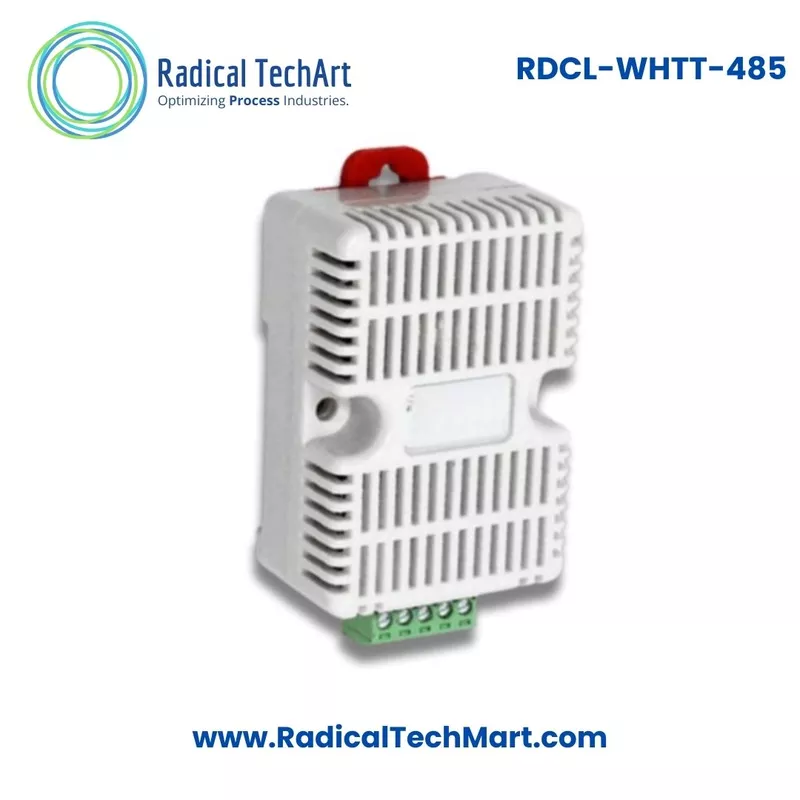


Wall-Mount Temperature and Humidity Transmitter with RS-485 Output
Download the manual here!!
Customize
Share :
A. Product overview
The Wall-Mount Temperature and Humidity Transmitter with RS-485 (Modbus-RTU) output is a compact industrial device for continuous monitoring of temperature and relative humidity in buildings and automation systems. It measures 0–100% RH and temperature from −40 to +80°C (model dependent) and transmits the readings digitally over an RS-485 Modbus-RTU network for easy integration with PLC, BMS, and SCADA systems.
Designed for reliable field performance, the transmitter operates on a wide 10–30 VDC supply range and features full isolation between power, sensing, and communication circuits. It supports multi-device (multi-drop) installations on a single RS-485 line and allows software configuration of address, baud rate, and parameters. Measured values can be read through Modbus registers for humidity and temperature.
B. Working principle
Sensing: Internal sensing elements continuously measure ambient humidity and temperature.
Signal processing: The transmitter conditions and scales the sensor signals to generate stable RH and temperature values with specified accuracy.
Isolation for reliability: Power, sensing, and communication/output circuits are electrically isolated to reduce interference, prevent ground loop issues, and improve safety in control panels and industrial installations.
Digital communication via RS-485 Modbus-RTU: The transmitter places measured values into Modbus registers. A PLC, BMS controller, SCADA system, or gateway polls the device over RS-485 and reads the data using Modbus function codes.
Multi-device bus support: Multiple transmitters can share the same RS-485 line by assigning unique Modbus addresses and using a common baud rate.
C. Why it is used
Reliable digital monitoring of temperature and humidity with Modbus RS-485 communication
Easy integration with PLC/BMS/SCADA and building automation systems without analog scaling errors
Multi-drop RS-485 wiring reduces cabling cost when monitoring many rooms/areas
Wide 10–30 VDC supply suits typical 24 VDC automation panels
Full isolation improves stability and reduces communication issues in electrically noisy environments
Software configuration of address and baud rate makes commissioning and expansion easy
Direct Modbus register reading supports data logging, alarms, and control logic in automation systems
D. Suitable buyers
Building automation (BMS/BAS) system integrators and HVAC controls contractors
PLC and SCADA automation integrators
Panel builders and OEMs making control panels, AHU control panels, and automation systems
Facility management teams for commercial buildings, warehouses, and industrial plants
Data centers, server rooms, and telecom/communication rooms needing continuous monitoring
Pharmaceutical labs, cleanrooms, and controlled environments using centralized monitoring
System integrators deploying Modbus gateways, IoT loggers, and energy management systems
FAQ
1. What is an RS-485 Modbus temperature and humidity transmitter?
It is a transmitter that measures temperature and relative humidity and sends the readings digitally over RS-485 using the Modbus-RTU protocol for PLC/BMS/SCADA integration.
2. What are the measurement ranges?
Humidity range is 0–100% RH. Temperature range is −40 to +80°C (model dependent/configurable).
3. What accuracy does it provide?
Typical accuracy is ±0.5°C for temperature and ±3% RH for humidity.
4. What power supply is required?
It operates on 10–30 VDC, which fits standard 24 VDC control panel supplies.
5. Can multiple transmitters be connected on one RS-485 line?
Yes. RS-485 supports multi-drop wiring. Each device must have a unique Modbus address and matching communication settings (baud rate, parity, etc.).
6. How do PLC/BMS/SCADA systems read the values?
The controller polls the transmitter using Modbus-RTU over RS-485 and reads the measurement registers. Common mapping is Humidity at register 40001 and Temperature at register 40002 (as provided).
7. What is the benefit of isolation in this transmitter?
Full isolation between power, sensing, and output/communication improves safety and reliability by reducing electrical noise effects and preventing ground loop problems.
8. Where is this transmitter typically used?
It is commonly used in building automation, HVAC monitoring, control panels, warehouses, communication rooms, server rooms, and other areas needing accurate temperature and humidity monitoring with Modbus connectivity.