

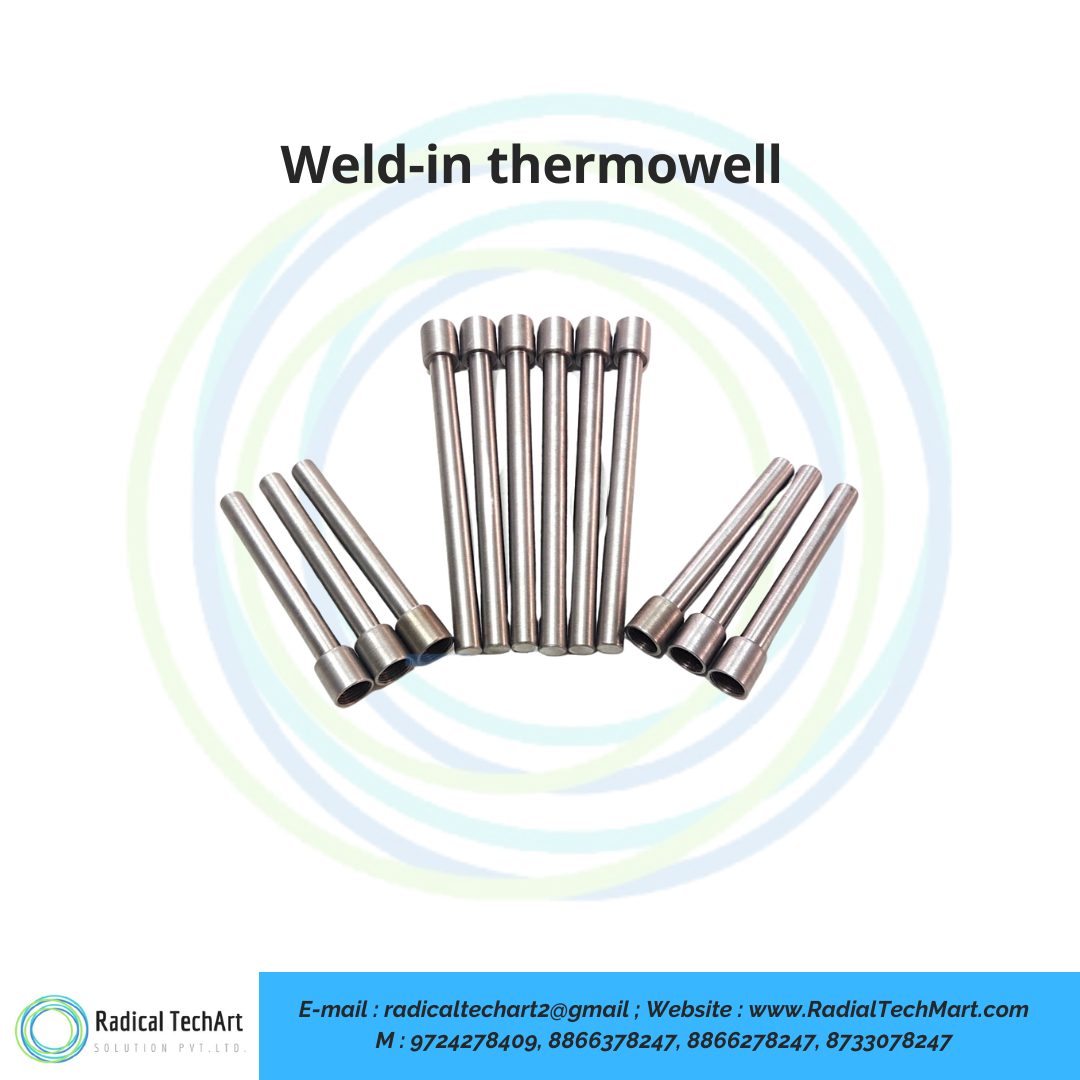
Weld-In Thermowell for RTD and Thermocouple Sensors
Weld-in thermowell is a solid and reliable temperature sensor protection fitting designed for high-pressure, high-temperature and corrosive industrial process applications. It is welded directly into a pipe, vessel or tank to provide a permanent and secure installation for RTD and thermocouple sensors.
Customize
Share :
A. Product Overview
A weld-in thermowell is used to protect temperature sensors from direct contact with process media. It is installed by welding the thermowell directly into a hole or connection point on a pipeline, tank, vessel or process equipment.
This type of thermowell is suitable for applications where threaded or flanged connections are not preferred due to high pressure, high temperature, vibration, corrosive fluids or limited installation space.
Weld-in thermowells are commonly available in different materials such as SS304, SS316 and SS316L. They can be supplied with different probe diameters, bore diameters, insertion lengths and shank styles such as straight, stepped and tapered, depending on the process requirement.
B. Working Principle
The weld-in thermowell acts as a protective barrier between the temperature sensor and the process media. The thermowell is welded permanently into the process line or vessel. After installation, the temperature sensor such as an RTD or thermocouple is inserted inside the bore of the thermowell.
The process temperature is transferred from the fluid or gas to the thermowell body and then to the sensor installed inside it. This allows accurate temperature measurement without exposing the sensor directly to pressure, flow, vibration or corrosive media.
If the sensor needs maintenance or replacement, it can be removed from the thermowell without opening the process line, which helps reduce downtime and improves safety.
C. Why It Is Used
Weld-in thermowells are used because they provide strong, permanent and safe protection for temperature sensors in demanding process conditions.
They are mainly used for:
Protecting RTD and thermocouple sensors from process media
Handling high-pressure and high-temperature applications
Providing permanent and leak-resistant installation
Improving temperature sensor life
Allowing sensor replacement without stopping the process
Reducing damage caused by flow, vibration and corrosion
Supporting reliable temperature measurement in critical industrial systems
They are preferred in heavy-duty applications where a normal threaded thermowell may not be strong enough and where a flanged thermowell may not be suitable due to space or design limitations.
D. Suitable Buyers
This product is suitable for:
Instrumentation engineers
Process engineers
Maintenance engineers
Plant engineers
Project contractors
Panel builders
OEM machine manufacturers
Chemical plant operators
Pharmaceutical plant operators
Food and beverage processing units
Oil and gas industries
Petrochemical plants
Power plants
Water treatment plants
Boiler and heat exchanger manufacturers
Industrial automation suppliers
Temperature sensor manufacturers and traders
FAQ
1. What is a weld-in thermowell?
A weld-in thermowell is a temperature sensor protection fitting that is welded directly into a pipe, tank or vessel. It protects RTD and thermocouple sensors from pressure, temperature, corrosion and process flow.
2. Where is a weld-in thermowell used?
It is used in pipelines, vessels, tanks, boilers, heat exchangers, chemical plants, refineries, power plants, pharmaceutical plants, food processing units and other industrial temperature measurement applications.
3. Why should I use a weld-in thermowell?
You should use a weld-in thermowell when you need a strong, permanent and secure connection for temperature measurement in high-pressure or high-temperature process conditions.
4. Which sensors can be used with weld-in thermowells?
Weld-in thermowells are commonly used with RTD sensors, thermocouples, temperature gauges and temperature transmitters.
5. What materials are available for weld-in thermowells?
Common materials include SS304, SS316 and SS316L. The material selection depends on the process media, temperature, pressure and corrosion level.
6. What are the common shank styles in weld-in thermowells?
Common shank styles include straight shank, stepped shank and tapered shank. Tapered shank designs are often preferred for better strength and faster response.
7. Can the temperature sensor be removed after installation?
Yes. The sensor can be removed from the thermowell for calibration, replacement or maintenance without removing the thermowell from the process line.
8. Is a weld-in thermowell suitable for high-pressure applications?
Yes. Weld-in thermowells are commonly used in high-pressure applications because the welded connection provides strong and permanent installation.
9. What details are required before buying a weld-in thermowell?
Before buying, confirm the process connection, material, insertion length, bore diameter, probe diameter, shank style, sensor thread size, pressure rating, temperature range and process media.
10. What is the difference between weld-in thermowell and threaded thermowell?
A threaded thermowell is screwed into a threaded process connection, while a weld-in thermowell is permanently welded into the process line or vessel. Weld-in thermowells are preferred for stronger and more permanent installation.