






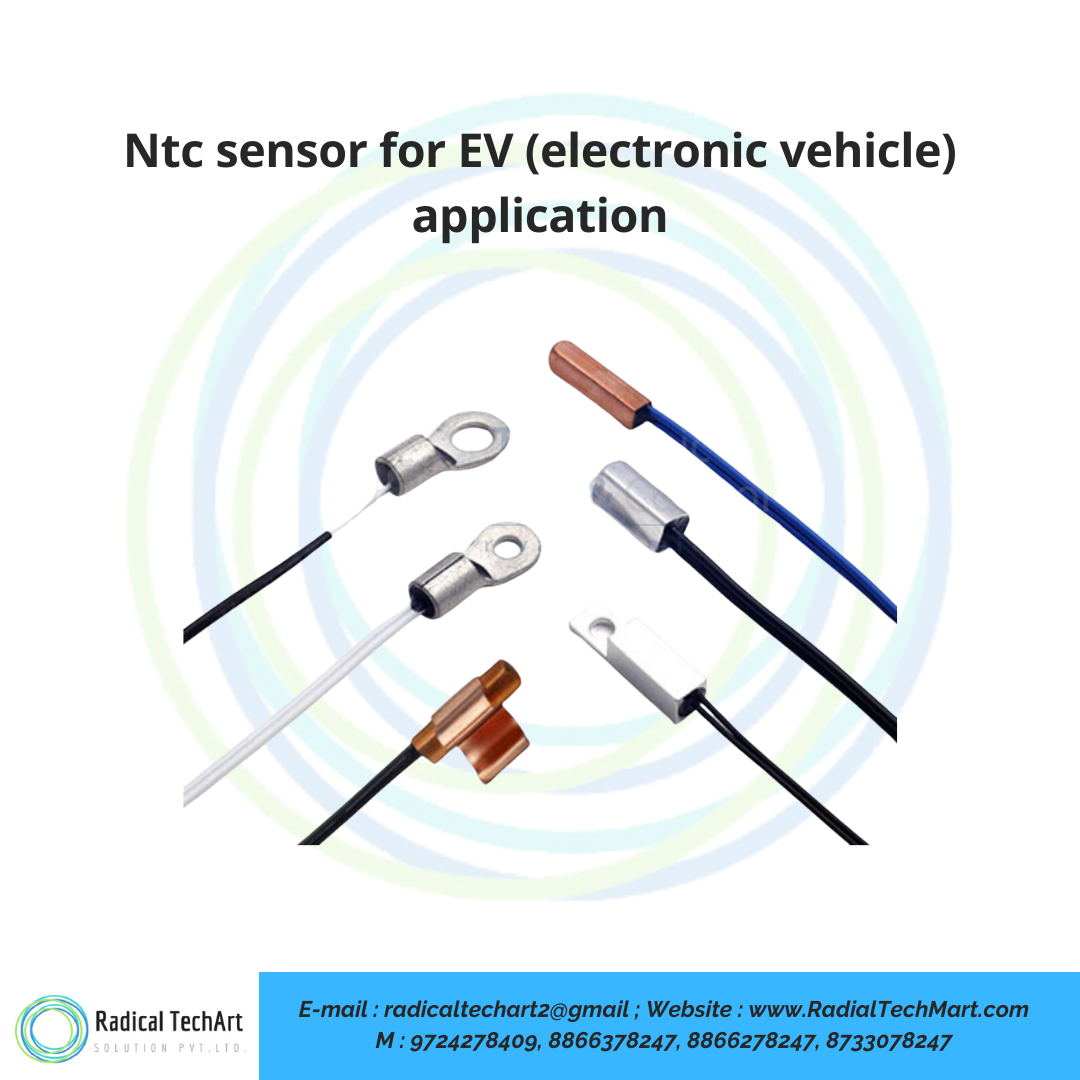
NTC Sensor for EV Battery and Electric Vehicle Temperature Monitoring
Customize
Share :
A. Product Overview
An NTC sensor for EV electric vehicle application is a temperature sensing component used to monitor heat levels in critical electric vehicle systems. NTC stands for Negative Temperature Coefficient, which means the sensor’s resistance decreases as the temperature increases.
In electric vehicles, NTC sensors are mainly used in battery packs, battery management systems, electric motors, charging connectors, charging cables, inverters, converters, and ambient air temperature monitoring. These sensors provide reliable temperature feedback to the control system so that the EV can operate safely and efficiently.
EV batteries and power electronics generate heat during charging, discharging, acceleration, and continuous operation. If this heat is not monitored properly, it can reduce battery life, affect vehicle performance, and create safety risks. NTC sensors help detect temperature changes quickly and support proper thermal management.
These sensors are available in different designs such as probe type NTC sensors, ring type NTC sensors, cable type NTC sensors, surface mounted NTC sensors, and customized NTC thermistor assemblies depending on the application requirement.
B. Working Principle
The working principle of an NTC sensor is based on resistance variation with temperature. When the temperature around the sensor increases, the resistance of the NTC thermistor decreases. When the temperature decreases, the resistance increases.
This resistance change is measured by the EV control system or battery management system. The system then converts the resistance value into a temperature reading. Based on this temperature data, the system can control cooling fans, liquid cooling systems, charging speed, motor protection, and battery safety functions.
For example, in an EV battery pack, the NTC sensor continuously monitors the cell or module temperature. If the battery temperature rises above the safe limit, the BMS can reduce charging current, activate cooling, limit power output, or trigger a safety warning.
C. Why It Is Used
NTC sensors are used in electric vehicles because accurate temperature monitoring is essential for safety, performance, and long-term reliability.
They are used for battery temperature sensing to prevent overheating, improve battery life, and reduce the risk of thermal runaway. They help the battery management system monitor the battery pack during charging and discharging.
They are also used for motor temperature sensing to protect the motor from overheating during high load conditions. In motor applications, NTC sensors can be installed near the motor casing or winding area to provide temperature feedback.
In EV charging systems, NTC sensors monitor the temperature of charging cables, charging connectors, and charging ports. This helps prevent overheating during fast charging and supports safe charging operation.
NTC sensors are also used in inverters, converters, and power electronics to protect electronic components from excessive heat. In addition, they can be used for ambient air temperature sensing in HVAC and cabin climate control systems.
Main reasons for using NTC sensors in EV applications include:
- Accurate temperature measurement
- Fast response to temperature changes
- Compact size for easy installation
- Suitable for battery pack integration
- Reliable performance in EV thermal management
- Protection against overheating
- Improved charging safety
- Better battery performance and life
- Support for BMS and vehicle control systems
- Cost-effective temperature sensing solution
D. Suitable Buyers
NTC sensors for EV applications are suitable for manufacturers, engineers, and suppliers working in electric vehicle and battery-related industries.
Suitable buyers include:
- Electric vehicle manufacturers
- EV battery pack manufacturers
- Lithium battery manufacturers
- Battery management system manufacturers
- EV charger manufacturers
- Charging station manufacturers
- Electric two-wheeler manufacturers
- Electric three-wheeler manufacturers
- Electric car manufacturers
- Electric bus manufacturers
- Motor controller manufacturers
- Inverter and converter manufacturers
- Automotive electronics manufacturers
- EV component suppliers
- Research and development labs
- Industrial automation companies working on EV systems
- OEMs and system integrators
These sensors are ideal for buyers who need reliable temperature monitoring in battery packs, charging systems, motors, power electronics, and EV safety applications.
FAQ
1. What is an NTC sensor used for in electric vehicles?
An NTC sensor is used in electric vehicles to monitor temperature in battery packs, BMS, motors, charging cables, charging connectors, charging ports, inverters, converters, and HVAC systems.
2. Why is battery temperature monitoring important in EVs?
Battery temperature monitoring is important because excessive heat can reduce battery life, affect performance, and increase the risk of thermal runaway. NTC sensors help the BMS maintain safe battery temperature levels.
3. Can NTC sensors be used in EV battery packs?
Yes, NTC sensors are commonly used in EV battery packs for cell temperature monitoring, module temperature monitoring, and battery thermal management.
4. How does an NTC sensor work?
An NTC sensor works by changing its resistance according to temperature. As the temperature increases, its resistance decreases. This change is measured and converted into a temperature reading by the control system.
5. Where are NTC sensors installed in electric vehicles?
NTC sensors can be installed in battery packs, motor casings, motor windings, charging ports, charging cables, connectors, inverters, converters, and air temperature sensing locations.
6. Are NTC sensors suitable for EV charging applications?
Yes, NTC sensors are suitable for EV charging applications. They help monitor the temperature of the charging cable, connector, and port to prevent overheating during charging.
7. What should be considered while selecting an NTC sensor for EV applications?
Important selection factors include resistance value, temperature range, resistance-temperature curve, sensitivity, response time, cable insulation, mounting type, size, durability, and environmental protection.
8. Which type of NTC sensor is suitable for EV battery monitoring?
Probe type, ring type, surface mounted, and customized cable type NTC sensors are commonly used for EV battery monitoring depending on the battery pack design.
9. Can NTC sensors help prevent thermal runaway?
NTC sensors help detect abnormal temperature rise in battery packs. This temperature data allows the BMS to take protective action and reduce the risk of thermal runaway.
10. Are custom NTC sensors available for EV applications?
Yes, NTC sensors can be customized based on resistance value, cable length, connector type, mounting style, insulation material, temperature range, and application requirement.